I have been working on my laser cutter some more using the UV laser. Got the turn mirrors installed and took a pic at night. The specular reflection makes materials around it fluoresce.
UV Laser at night by macona, on Flickr

 Senior Member
 UV Laser at Night
I have been working on my laser cutter some more using the UV laser. Got the turn mirrors installed and took a pic at night. The specular reflection makes materials around it fluoresce.
UV Laser at night by macona, on Flickr
 Senior Member
Be sure to wear UV eye protection when working around it. You don't want premature cataracts.
Jem
Quote: "There is a theory which states that if ever, for any reason, anyone discovers what exactly the Universe is for and why it is here it will instantly disappear and be replaced by something even more bizarre and inexplicable. There is another that states that this has already happened.”... Douglas Adams 1952 - 2001
Senior Member
Yeah, I have a pair of goggles that are OD 7.77 at this wavelength.
Senior Member
Would regular polycarbonate be sufficient eye protection?

Senior Member
In actual fact Polycarbonate is an excellent UV blocker, as is regular CR39 Monomer which is also used for ophthalmic lenses, and it's certainly better than nothing.
However, you'll notice from your graph that it doesn't block all of the UV. For that to happen you need to treat the lenses with a molecular catalytic UV block. This tends to give the lenses a slight yellowish hue. We use a photospectrometer at work to ensure all UV is blocked when providing lenses to external sources for sunwear.
UV is absorbed by the crystalline lens in the eye which eventually turns it cloudy. This is generally why older people develop cataracts. Alternatively you could just use a UV laser without eye protection to shortcut the whole process
Quote: "There is a theory which states that if ever, for any reason, anyone discovers what exactly the Universe is for and why it is here it will instantly disappear and be replaced by something even more bizarre and inexplicable. There is another that states that this has already happened.”... Douglas Adams 1952 - 2001
 Creaky Old Award Winning Bastard Technologist
We were getting >99% adsorption at 351 nm Argon Ion with most ordinary home depot clear plastic glasses with clear frames. While we did not use the spectrophotomer, we used 1/3 watt at .65 millimeter diameter and a sensitive phosphor target as the test setup. Nothing, Nada, got through.
Of five different pairs we tested, one leaked like mad, around 20%, the rest were good adsorbers.
While I can't suggest that with a pulsed yag, it certainly was better then Nothing when we had no budget for more then 2 pairs...
I'll defer to Jem on this one, its his line of work, but if you have no choice and want something just a bit better then OD4, go to Home Deport or a machine tool place..
I just realized I'm the one that always preaches about NO homemade glasses, excuse me while I repeat "Hypocrit" 46,500 times.
So please just use them till you get PROFESSIONAL ones, and enclose your beams for safety.
Steve
Last edited by mixedgas; 07-25-2012 at 15:30.
Senior Member
Plexiglass also makes a Acrylic specifically designed for filtering out UV. Called UF-3 and UF-5. According to thier spec sheet it absorbs "all" UV below 390nm and Absorbs quite a bit of the 400-450 range as well.
http://www.buildlog.net/forum/viewtopic.php?f=20&t=1430
I do have a Radoma Spectroradiometer here at home to check stuff with.
The entire enclosure is built to have panels installed to enclose it. It came with smoked plastic panels, I am not sure if it is acrylic or PC. What I might do is paint the inside of the panels black and then use a piece of UF-3 for the door.
I have noticed that the commercial machines with 355nm lasers have what looks like smoked glass or plastic for their windows.
The external beam area is enclosed in aluminum tubing between the mirrors:
Turn optics installed by macona, on Flickr
Senior Member
Looking good! The reflections off a piece of acrylic (viewed on a florescing target through a decent pair of googles of course) are mezmorizing as it begins to melt.
Out of curiosity, where did the rest of the frame/mechanics come from? It looks pretty well built!
Senior Member
It is (was) a Hamilton STARlet ( http://www.hamiltonrobotics.com/hami...obotics/star0/ ) It was bought by FEI for a project to do automated loading of wafers into their SEM/FIB systems. FEI slightly modified them and they eventually ended up in the basement after the project was either finished or they did something else. I heard they cost around $45k. I got it through my surplus friend who rescued them from being scrapped. He tried to sell them for quite some time, even back to the manufacturer for parts but no one was interested. It hit on me that they would make a good laser cutter so I got one of them. I pretty much ripped out all the electronics in it and replaced it with my own. I was able to reuse 2 of the three motors and the linear encoder. I did install a heidenhain linear encoder on the short axis (seen above) that should give me 2.5um resolution on that axis and 10um on the other with the stock encoder strip.
I have a build log of what I have done one it. Started over 2 years ago. I mostly stopped working on it when I started at Laika.
http://www.buildlog.net/forum/viewtopic.php?f=16&t=264
I had the same visual effect when I tried an aluminum first surface mirror on it. The reflection was rather interesting!
Aluminum mirror meets UV laser by macona, on Flickr
Senior Member
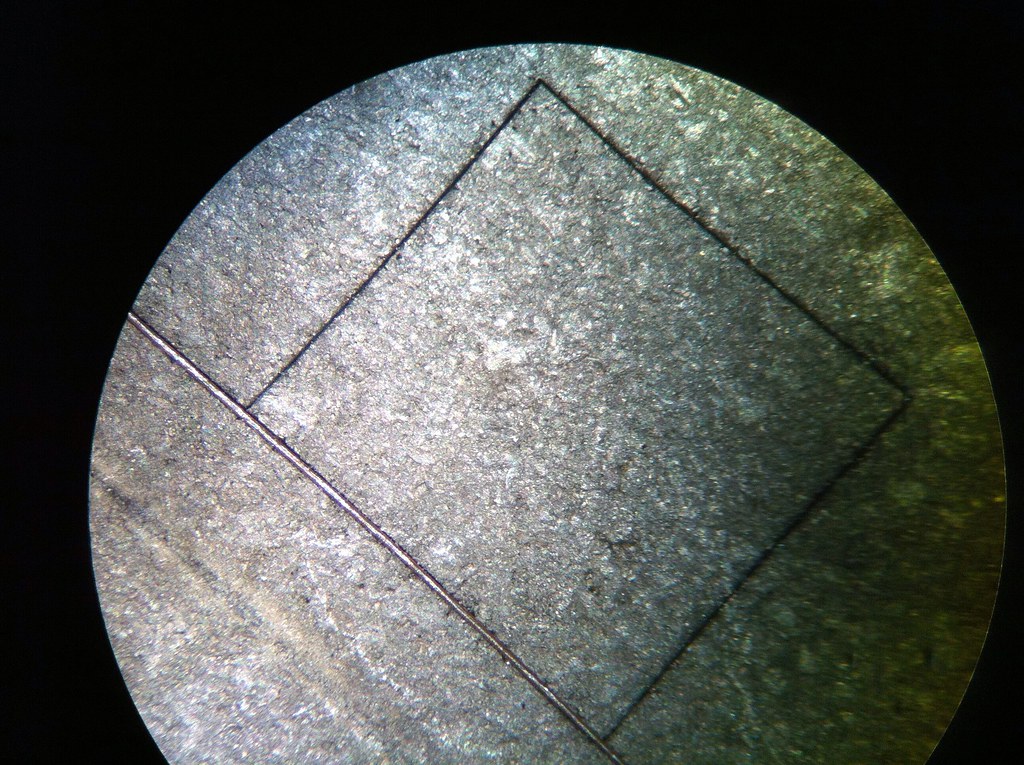
With the optics on the gantry of my laser cutter mostly finished I decided to see what it can do. I dont have the drives hooked up right now so I moved the gantry by hand and cut a little square in some EDM graphite. I took a pic under my stereo microscope, the wire like thing is a hair. The groove is pretty deep relative to it's width.
Cut in edm graphite by macona, on Flickr
Cut in edm graphite by macona, on Flickr

 Posting Permissions


 Reply With Quote