


I got the idea of hysteresis when seeing that the error in my rotating line doesn't appear smoothly rising out of each axis it passes though, there's a kind of 'sticky' quality, like when pulling a magnet away from steel. I think the WideMoves have at least two different problems, perhaps.
The speeds of the scanners might be different and I like this idea, I'll look into this closely soon. Speed difference and 'stickiness' will combine to form the separation of draw and return draw. Note the asymmetry in my rotating line AVI, especially at the horizontal and vertical orientations where the stickiness is very magnet-like, causing early collapse into single-axis drawing, and a tendency to retain that state as rotation continues to use both axes again. Stepping through frame by frame helps, each shows one degree of rotation.
There are two things that should minimise the speed difference effect in my WAV file though, one is the dwell points, the other is interpolation needed to make the wave. I have no 'points' at all except those vertices at the ends of the drawn line. The dwell points ensure that both scanners are stationary for a moment, at the same time. Then, the interpolation means they draw steadily, in effect a lot of very tiny steps. I'm not saying that different servo gain or mechanical inertias aren't having an effect, but I am saying this implies they were not tuned well together at the factory. Individually, perhaps, but not together.
What line geometry does the Laser Media test pattern trace? I'm not sure I can interpret this from an ILDA file as I have nothing that uses those. I can easily emulate it exactly with a WAV file prepared by Lua script, if I know what it must draw, exactly, and how it traces between draws. A simple diagram will help a lot.
I recognise the problem of gain fighting damping. So far I doubt that's an issue in this case. I've also thought that it might be worth risking a bit of that, and running at slower speeds to prevent overheat. This could reduce the effect of that stickiness problem. I'll look at the difference in speeds first though. Am I right in thinking that gain adjustment can be used to compensate for slight differences in inertia? I think that's what it has to do to make sure the speeds are the same for the same input, because it's not actually the speed, so much as the acceleration, that matters.
Edit: Surreal habit of mine, topping three pages in a row now...

 Reply With Quote
 Originally Posted by The_Doctor

 Added stuff. I haven't done new tests yet, I've still got enough material from earlier ones to use to show the problem. Your file reminded me of that, so it is a useful way to separate the two possible causes. This isn't phase/gain related. That exists too, but appears only to contribute to a little rotational asymettry, and even most of that is due to one galvo being 'sticker' than the other.


 Hmm, well, though the connector is a bit different, the BODY has GOT TO HAVE been made nearly-identical (down to the bearings) thru SOME sort of 'co-operation', at least... no way this is 'coincidence'...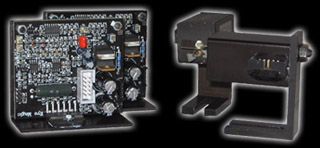

 EMS was the originator of this body-design, NOT MediaLas - MY GUESS, is that Tom (EMS) sold either 'rights-to-develop' off his new 'body-design' and MediaLas modified / and or integrated their design for the unique characteristics that make them 'wide-move's vs straight EMS - (ie driver, position detector and no-mechanical 'stop' differences, etc..) OR - they are, in fact, just 'modified' EMS 4Ks - dunno, but IF you can post pix of the INSIDE of the 'WideMove's, I can likely discern more about this possible connection...
 but if you have postable / emailable pix of the INSIDE of your XTs, those would be very helpful to see, cause we do not (currently) have any WideMoves TO check / report...
 ....and armed only with his trusty 21 Zorgawatt KTiOPO4...
